




Number Plate Position Law UK: Where and How Plates Must Be Fitted


Number plate position law in the UK, the short answer: a car’s front and rear plates must be fixed vertically (or as close to vertical as is reasonably practicable), in a position where the registration is easily readable in daylight, and the rear plate must be lit at night. Nothing fitted to or around the plate, from screws to a bike rack, can make the characters harder to read. The law doesn’t say a plate has to be exactly central.
Written by the PlateBoss team, led by owner HD. We’ve been making plates since 2019 and are a DVLA-registered number plate supplier with a workshop in Hounslow, west London. Checked against the Road Vehicles (Display of Registration Marks) Regulations 2001, DVLA leaflet INF104 and GOV.UK guidance on number plates, October 2026. How we write our guides.
In this guide
- Where the law says plates must go
- How readable a plate has to be
- Rear plate lighting
- Things that can make a plate illegal
- The mistake we see most: off-centre plates
- FAQs
Where the law says plates must go
The rules on fitting are in the Road Vehicles (Display of Registration Marks) Regulations 2001. For cars first registered from 1 September 2001:
- Rear plate: must be fixed on the back of the car. When you’re towing, it goes on the back of the trailer instead (see our guide to trailer number plate rules).
- Front plate: must be fixed on the front of the car. Our guide to front number plate law covers which vehicles need one.
- Angle: both plates must be fixed vertically or, where that isn’t reasonably practicable, as close to vertical as possible. A plate tilted back to look sleek doesn’t meet this if the car has a vertical mounting point.
Motorbikes registered from September 2001 only display a rear plate.

How readable a plate has to be
The regulations don’t give a height off the ground. Instead they set a readability test: in normal daylight, the characters must be easily distinguishable from every part of an area around the plate. For standard 50mm-wide car characters, that area has a diagonal length of 21.5 metres.
In plain terms, someone standing a good distance away and off to one side should still be able to read your registration. A plate tucked under a bumper lip, angled sharply or partly hidden fails that test even if it’s a perfectly legal plate.
Not sure your plates are fitted properly? We fit while you wait at our Hounslow workshop, straight and level.
See our fitting serviceAsk us on WhatsAppRear plate lighting
Between sunset and sunrise the rear plate must be lit so it’s easily readable from an area with a diagonal length of 18 metres. That’s what the number plate lamp is for, and a blown bulb is an MOT issue as well as a roadside one. Our guide to number plate MOT fails covers how the lamp is tested.
Things that can make a plate illegal
The regulations say a plate must not be treated or fixed in a way that makes the characters less easy to read. In practice that covers:
- Screws through the characters, or bolts placed to change how a letter or number looks. INF104 gives this as an example of misrepresenting a registration. Our guide to pre-drilled number plates shows where screws should go.
- Bike racks and tow bars that hide the rear plate. Because the plate has to stay readable, you need a plate fitted where it can be seen, such as on the rack itself.
- Dirt, covers and tints. Spray-on or clip-on covers and heavy dirt all make the plate harder to read.
- Surrounds or holders that cover the characters. A holder should sit around the plate, not over the registration.
Incorrectly displayed plates can mean a fine of up to £1,000 and an MOT fail.
The mistake we see most: off-centre plates
When cars come into our workshop, the most common fitting problem we see is plates that are off-centre. It usually happens when someone sticks a new plate over the outline of the old one, or lines it up by eye on a curved bumper.
An off-centre plate isn’t illegal in itself, as the law asks for a vertical, readable plate rather than a dead-central one. But it’s the first thing people notice, and it’s easy to avoid. If you’re fitting at home, measure from both ends of the bumper or tailgate recess and mark the centre before you stick anything down. Our guide on how to install number plates walks through it.

Plates and fitting kit



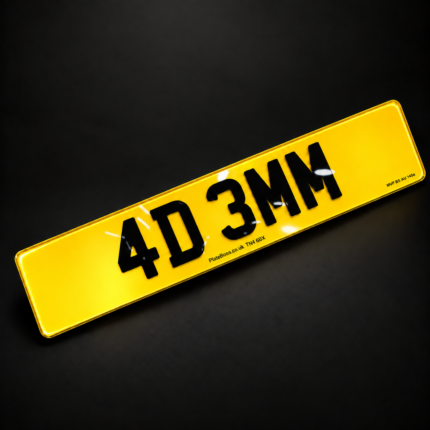
Plates made and fitted properly. Order before 2pm for same-day dispatch with free tracked delivery, or collect from our Hounslow workshop and we’ll fit them while you wait.
Shop number platesCollect in HounslowWhatsApp usNumber plate position law UK: FAQs
Is there a legal height for a number plate in the UK?
No height is set. The plate must be fixed vertically (or as near as practicable) and be easily readable in daylight from an area with a diagonal of about 21.5 metres for standard car characters.
Does a number plate have to be in the centre?
No. The law requires a vertical, readable plate, not a central one. Off-centre plates are legal but look wrong, so we always centre them when fitting.
Can a bike rack cover my number plate?
No. The rear plate has to stay readable, so if a rack or carrier hides it you need a plate fitted where it can be seen, such as on the rack.
Can I tilt my number plate?
Only if the car’s mounting point isn’t vertical. The rule is vertical, or as close to vertical as is reasonably practicable.
Does my rear number plate need a light?
Yes. Between sunset and sunrise the rear plate must be lit so it’s readable from an area with a diagonal of 18 metres.