




Pre-Drilled Number Plates: Why We Don’t Sell Them (and How to Drill Yours)


Pre drilled number plates, the short answer: we don’t sell them, because the holes almost never line up with the ones already on your car. Every make and model puts them in a different place. We only drill plates as part of our fitting service, where we can measure and drill on the car itself. If you’re fitting plates yourself, adhesive pads are usually the better choice, and if you do need screws, put the holes in the margins or the natural gaps so they never change how a character looks. Drilling a plate does void its warranty, whoever drills it.
Written by the PlateBoss team, led by owner HD. We’ve been making plates since 2019 and are a DVLA-registered number plate supplier with a workshop in Hounslow, west London. Checked against DVLA leaflet INF104 and GOV.UK guidance on number plates, October 2026. How we write our guides.
In this guide
- Why we don’t sell pre drilled number plates
- Drilling and your warranty
- Screws or pads? How we decide
- How to drill number plates if you must
- Where screws are allowed to go
- FAQs
Why we don’t sell pre drilled number plates
People sometimes ask us for pre drilled number plates, “same as the old ones”. It sounds simple, but in practice it doesn’t work.
The holes on your existing plates are wherever the last fitter, the dealer or the factory put them. From the plates we take off cars at the workshop, they’re always in a different place: different heights, different distances from the edge, sometimes slightly off-centre. Even two cars of the same model don’t always match.
So if we drilled a new plate blind, the chances are the holes would miss and you’d end up drilling a second set. That’s why we only drill as part of our number plate fitting service, where the plate is held up against the car and the holes are marked from the real mounting points.

Drilling and your warranty
Drilling a plate voids its warranty. That applies whether you drill it yourself or we drill it for you as part of fitting. A hole goes through the reflective face and the acrylic, so the plate is no longer in the condition it left our workshop.
That’s one more reason we don’t sell pre drilled number plates or drill unless it’s needed. If adhesive pads will do the job, the plate stays intact and covered.
Screws or pads? How we decide
When we fit plates at the workshop, pads are our default, and they’re what we always recommend. They don’t void the warranty, and because the plate is never drilled, it lasts longer. That matters most with a private plate, which may well be taken off and moved to another car one day. We only use screws when:
- The customer asks for screws, and the plates aren’t private plates; or
- The surface is uneven, so pads can’t hold the plate flat against it.
Good adhesive pads hold a plate firmly on a flat, clean surface, they leave no holes in the plate or the car, and they keep screw heads away from the characters. For a front plate on an uneven grille or bumper, thicker 5mm pads can help bridge the gaps. Our guide to front number plate law covers the different ways of fitting a front plate.
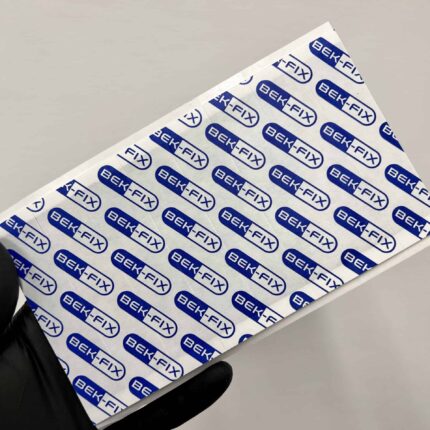
Fitting them yourself? Our extra strong adhesive pads are £4.99 for a pack of 8, and every plate order has a fixing kit option.
Get adhesive padsSend us a photo on WhatsAppHow to drill number plates if you must
If your car only takes screws, this is how to drill number plates the way we do at the workshop. The key is a small pilot hole and a slow speed, so the acrylic doesn’t crack:
- Offer the plate up to the car. Hold it in place, centred, and mark where the car’s mounting points are. Measure from the fixings on the car, not from the holes in the old plate.
- Check the marks against the characters. Each hole should sit in the margin or in the gap between characters, never on a character.
- Drill a small pilot hole first, at slow speed, with the plate supported on a flat piece of wood so the acrylic doesn’t crack.
- Open the hole up gradually to the screw size, rather than using one big bit straight away.
- Use screw caps that match the background, white at the front and yellow at the back, so they don’t stand out or look like part of a character.
The full step-by-step for fitting, including taking old plates off, is in our guide on how to install number plates.
Where screws are allowed to go
The DVLA’s leaflet INF104 doesn’t let you use fixing bolts to change how a registration looks. A black screw cap in the middle of a character, or one that closes off a letter so it reads as another, makes the plate illegal. We cover that trick and others in our guide to number plate spacing.
Keep fixings in the margins or in the natural spaces between characters and groups, use matching caps, and you’ll be on the right side of the rules.
Plates and fixings
Rather we fitted them? Collect from our Hounslow workshop and we can fit your plates while you wait, or order online before 2pm for same-day dispatch.
Shop number platesCollect in HounslowWhatsApp usPre drilled number plates: FAQs
Can I buy pre drilled number plates?
We don’t sell them, because the mounting holes on every car are in a different place and pre-drilled holes rarely line up. We drill plates only as part of our fitting service, matched to the car.
Does drilling a number plate void the warranty?
Yes. Drilling a plate voids its warranty, whether you drill it or we drill it during fitting. That’s why we always recommend adhesive pads where the surface allows.
Are adhesive pads strong enough for number plates?
Yes, on a flat, clean surface. Good quality pads hold plates firmly without any holes. On an uneven surface, thicker 5mm pads or screws may be needed.
Where should screw holes go on a number plate?
In the margins or in the natural gaps between characters and groups. They must never sit on a character or change how a letter or number looks.
What colour screw caps should I use?
Caps that match the plate background: white on the front plate and yellow on the rear. Black caps can look like part of a character.
Can I use my old plates as a drilling template?
It’s better to measure from the mounting points on the car. Old plates may have been drilled in the wrong place, and a new plate’s layout can differ slightly.
Will you drill plates if I collect them?
We drill when we fit the plates for you, so the holes match the car. Ask about fitting when you collect from Hounslow.